Ask for a reprint
email :
* Give your email
2026
ACL
|
Alejandra Palomino, Aneta Slodczyk, Aurélien Canizarès, Rémi Champallier, Stéphane Bostyn, Encarnacion Raymundo-Piñero, 'Monitoring the hydrothermal carbonization of biomass derived compounds by in-situ high-temperature-high-pressure Raman spectroscopy', Carbon 251 (2026) doi:10.1016/j.carbon.2026.121360
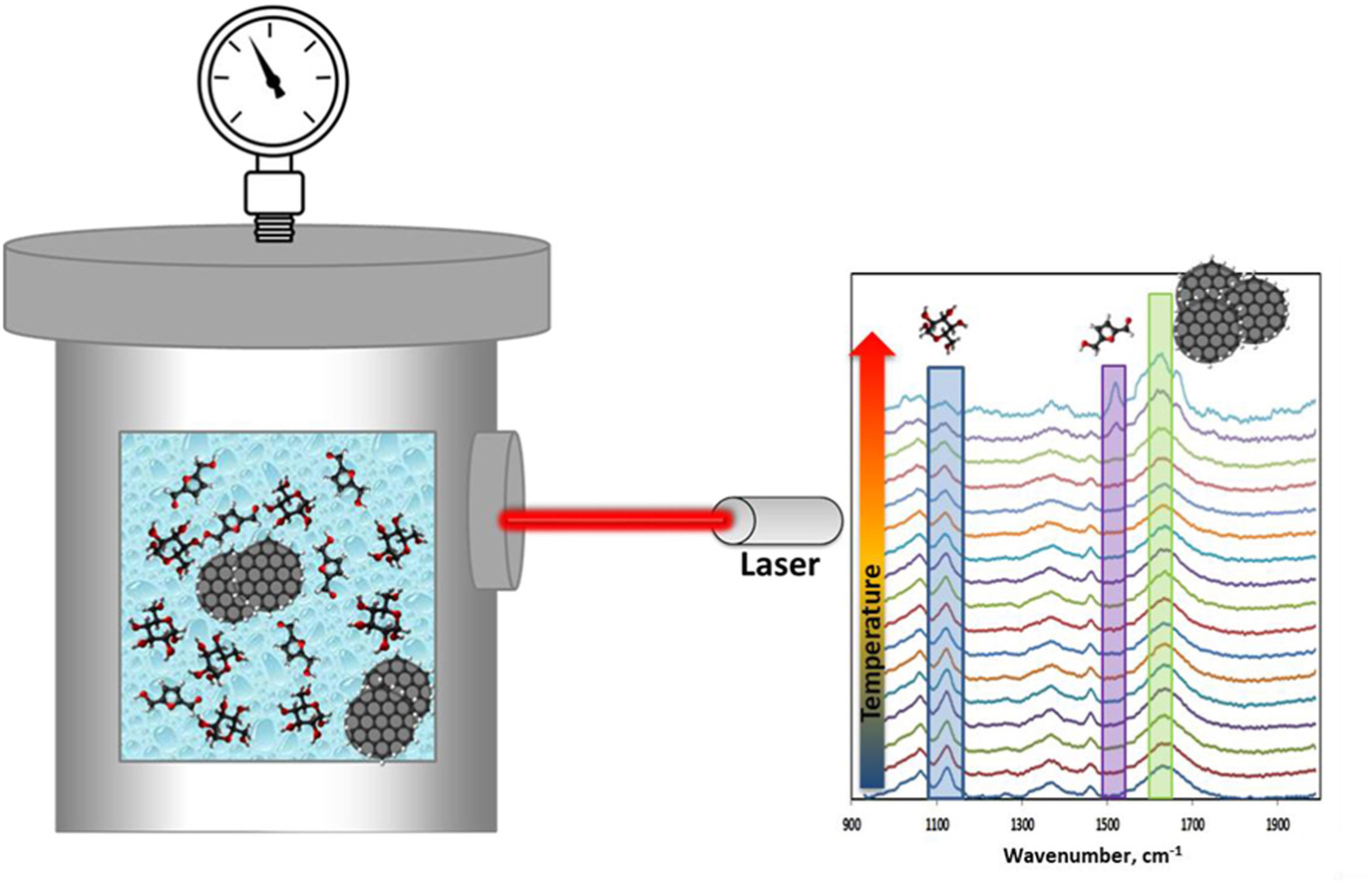
Hydrothermal carbonization (HTC) is an energy efficient and sustainable method for converting biomass into carbon-based materials at low temperatures. However, the specific reaction conditions, involving the heating of feedstock in a confined environment under autogenous pressure, pose significant challenges for in-situ analytical techniques. To date, kinetic studies of HTC have primarily relied on ex-situ chemical analysis of samples collected during or after HTC runs. This study presents a novel approach utilizing continuous and rapid in-situ Raman spectroscopy to investigate the reaction progress in aqueous media, shedding light on the reaction pathways and kinetics of hydrothermal reactions. A custom-designed heated pressure vessel equipped with sapphire windows enabled the in-situ Raman monitoring of hydrothermal carbonization of biomass derivatives, such as glucose and xylose, under various experimental conditions including different heating rates and pressures. The results were compared with Raman data obtained ex-situ from a classical batch reactor at different reaction times. The in-situ measurements provided valuable insights into the composition of intermediates and products in both the liquid and solid phases simultaneously, yielding information that cannot be obtained through ex-situ analysis, such as the temperature of sugar decomposition and carbon precipitation depending on the nature of the sugar, the heating rate or the pressure.
|
|